


Hey there! As a supplier of Ceramic Fiber Paper, I often get asked some pretty interesting questions. One that comes up quite a bit is whether ceramic fiber paper can be used in nuclear radiation environments. Let's dig into this topic and see what we can find out.
First off, let's talk a bit about what ceramic fiber paper is. Ceramic fiber paper is made from ceramic fibers that are processed into a paper - like material. It's known for its excellent thermal insulation properties, low heat storage, and good chemical stability. You can check out more about it here. It's used in a wide range of industries, from aerospace to manufacturing, mainly for insulation purposes.
Now, when it comes to nuclear radiation environments, things get a bit more complicated. Nuclear radiation includes alpha particles, beta particles, gamma rays, and neutrons. Each type of radiation has different properties and interacts with materials in different ways.
Let's start with alpha particles. These are relatively large and heavy particles, consisting of two protons and two neutrons. They don't penetrate very far into materials. In fact, a sheet of paper can stop most alpha particles. Ceramic fiber paper, with its dense fiber structure, can also act as a good barrier against alpha particles. So, in terms of alpha radiation, ceramic fiber paper can definitely be used as a basic protective layer.
Beta particles are smaller and more energetic than alpha particles. They can penetrate deeper into materials. Ceramic fiber paper can provide some protection against beta particles, but its effectiveness depends on the thickness and density of the paper. Thicker and denser ceramic fiber paper will offer better protection. However, for high - energy beta radiation, additional shielding might be required.
Gamma rays are a form of electromagnetic radiation with high energy and very high penetrating power. Ceramic fiber paper, on its own, is not very effective at blocking gamma rays. Gamma rays can pass through most materials, and you usually need dense materials like lead or concrete for effective shielding. So, if you're dealing with a high - gamma - radiation environment, ceramic fiber paper won't be your go - to shielding material.
Neutrons are a bit tricky. They have no charge, which means they interact differently with materials compared to charged particles like alpha and beta particles. Neutron shielding often requires materials that can slow down and absorb neutrons. Some elements like hydrogen, boron, and lithium are good at neutron absorption. Ceramic fiber paper doesn't have a high content of these elements, so its ability to shield neutrons is limited.
But here's the thing. In many nuclear facilities, the radiation environment is a mix of different types of radiation. And ceramic fiber paper might still have a role to play. For example, in areas where the alpha and beta radiation levels are relatively high, and gamma and neutron radiation levels are low, ceramic fiber paper can be used as part of a multi - layer shielding system. It can be combined with other materials to provide comprehensive protection.
Also, ceramic fiber paper has other advantages in a nuclear environment. Its thermal insulation properties can be useful in areas where there's heat generation along with radiation. For instance, in some nuclear reactors, there are parts that need to be kept at a certain temperature while being protected from radiation. Ceramic fiber paper can help with the thermal management aspect.
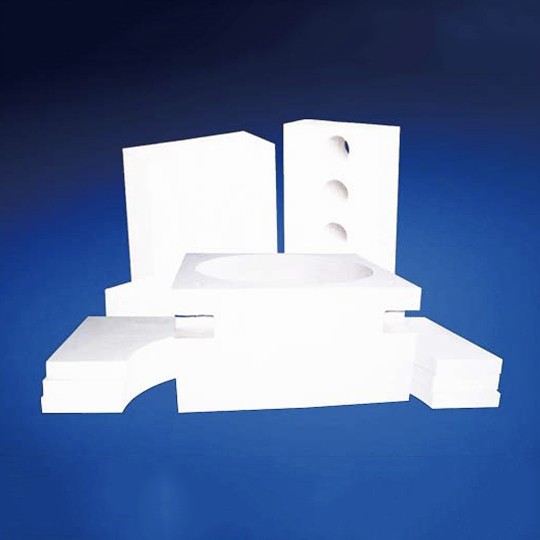
If you're involved in a nuclear project and need different ceramic fiber products, we also offer Ceramic Fiber Module and Ceramic Fiber Shaped Parts. These products can be customized to fit your specific needs.
In conclusion, while ceramic fiber paper can't be used as a standalone shielding material in all nuclear radiation environments, it can be a valuable part of a shielding solution in certain situations. Its ability to block alpha and beta particles, along with its thermal insulation properties, make it a candidate for use in some nuclear applications.
If you're interested in learning more about how ceramic fiber paper or our other products can be used in your nuclear project, I'd love to have a chat with you. Reach out and we can discuss your requirements in detail. Whether it's about the right thickness of the paper, the combination with other materials, or any other questions, I'm here to help.

References:
- "Radiation Protection: A Guide for Scientists and Physicians" by Michael Goans
- "Materials for Nuclear Applications" by various authors in the Journal of Nuclear Materials Science


